Introducing Dovetail Coworker
Dovetail Coworker is now available in Slack and Teams. Regulatory help where your team works, with experts responsible for judgment and review.
Dovetail Coworker is now available in Slack and Teams. Regulatory help where your team works, with experts responsible for judgment and review.
Keep medtech training tied to current document revisions. QMS Plus uses your group mappings to assign work and keep signed records with the relevant revision.
Compliance tools are growing by the dozens but they can't solve your key strategy questions or talk to auditors for you just yet. Understand each tools limitations, and position them tools alongside an expert strategically to get the most out of them.
Choose the right clinical evidence approach and you can build a plan that satisfies the EU, UK, and US regulatory requirements all at once.
A founder's guide to European investors funding medtech in 2026, what they back, and what they want to see before they write the cheque.
At Dovetail, we believe in human judgement alongside brilliant AI. AI has brought unbridled efficiency to our work and intelligence to our fingertips that was previously inaccessible. You could have it build any document with the right context. It’s enough to do just about anything. But not everything. It

We built our own AI-native collaboration suite, and the conversation now includes the Dovetail agent. It reads every comment and redline in your document and acts on it, right inside your ISO 13485 quality system. A huge time saver for teams, and it's available now for all users.
Dovetail's agent learns from the decisions, facts, and expert feedback in your calls and written work, not just chats. It remembers what matters, keeps getting better for you, and keeps your data private.
America turns 250 this year. For UK medtech, the US market is still the market worth crossing an ocean for. Standing at the door to the US market is the FDA, and (surprise!) it works nothing like the MHRA or a Notified Body.

Same team, same platform, new name. Our experts dovetail into your team, our platform dovetails into the tools you already use, and the device you've built reaches the people who need it most. That's why we're now Dovetail.
TL;DR A Q-Submission (most often a Pre-Sub) is a free, formal way to get FDA’s written feedback on your device and your submission plan before you file. You send a short package with specific questions, FDA responds in writing within about 75 days, and they usually
A few weeks ago, the FDA sent a warning letter to Purolea Cosmetics Lab. It's been getting a lot of attention, mostly framed as a warning shot at AI in pharmaceutical manufacturing. "FDA says AI is a liability." That kind of thing. I want to offer
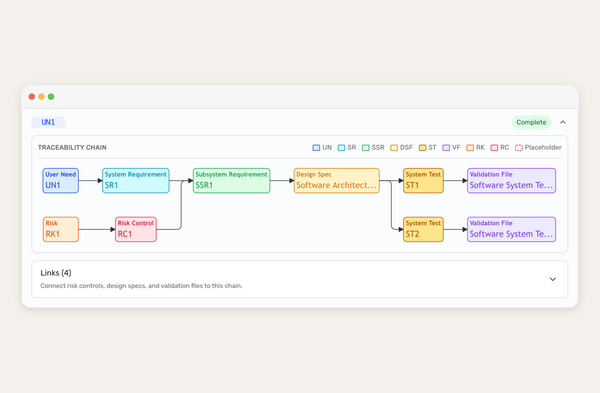
Formly's new traceability matrix auto-links every requirement from User Needs through Validation, exposes that traceability graph to AI agents via MCP, and finally looks like something worth using.
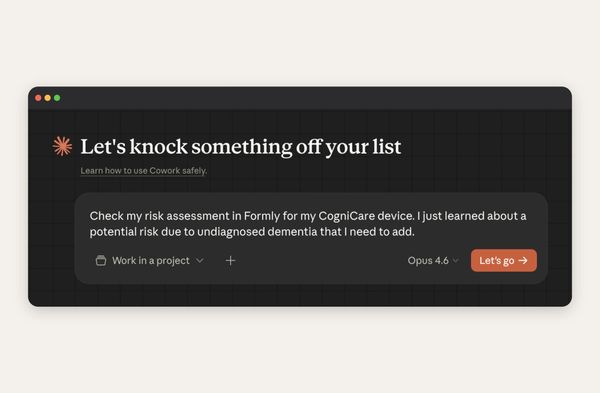
Formly now has an MCP server. Connect your Formly workspace directly to Claude or GPT and run regulatory research, standards lookup, and expert review without switching tools.
Compared to other regulatory authorities across the world, the FDA’s approach to regulations and engaging with companies looking to clear their medical devices is unique. The predicate system, enforcement discretion products, and the De Novo pathway, to name a few, are regulatory concepts that are unlike most other countries.
TL;DR If you're building a medical device, ISO 14971 is your blueprint for making sure it’s safe, and not just “we hope it doesn’t explode” safe. It's a structured way to think through what could go wrong, how bad that would be, how
TL;DR If you're building a medical device, ISO 14971 is a necessity as it is your blueprint for safety. It’s a formal process for figuring out what could possibly go wrong (hazards and harms), so you can manage those risks before they ever reach a patient.
TL;DR (too lazy, didn’t read) Medical devices need to meet specific performance and safety requirements called GSPRs (General Safety and Performance Requirements) before they can be sold in Europe. Essentially it's like a super-detailed safety checklist that ensures medical devices are safe and work like

TL;DR (too lazy, didn’t read) IEC 62304 is basically the rulebook for medical device software development. Whether you're creating a standalone medical app or software that's built into medical devices, this standard tells you how to do it safely and properly. The standard has

TL;DR (too lazy, didn’t read) Process validation is basically making sure medical devices are manufactured consistently and safely, every time they're made. It's like having a foolproof recipe that guarantees your dish comes out perfect, except instead of a souffle, we're talking
We are excited to announce a new partnership between FormlyAI and QbD Group, a global leader in life sciences consultancy. This collaboration marks a significant step forward in enhancing efficiency and innovation in the life sciences industry. QbD Group, renowned for their comprehensive solutions across the life sciences sector, supports

1. Regulations are the same for all medical devices EU medical devices are categorized into 4 risk classes: Class I, Class IIa, Class IIb, and Class III. Your device designation is determined by things like invasiveness (is the device implanted?), intended purpose, duration of use, active vs. non-active (meaning
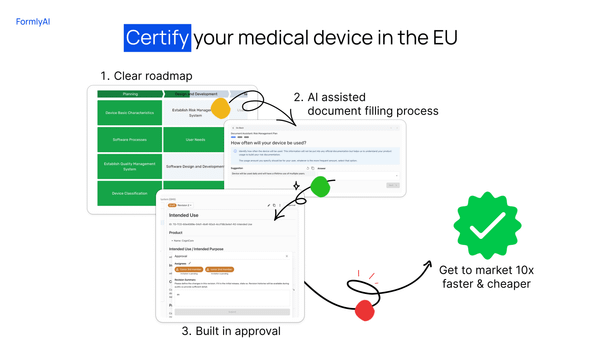
We have big news! FormlyAI now has a new eQMS! And better yet, we have new more affordable pricing. Also, we are excited to announce we have finally released our new electronic Quality Management System (eQMS) that allows you to store and approve your documentation within our Formly software. This
Corrective and Preventive Actions (CAPA) are how you fix issues that have been identified with your medical device. Think of it as a formal way of documenting your problem fixing process. What triggers a CAPA? Issues may come from adverse events, nonconformities, audits, customer complaints, a defective component, or if
